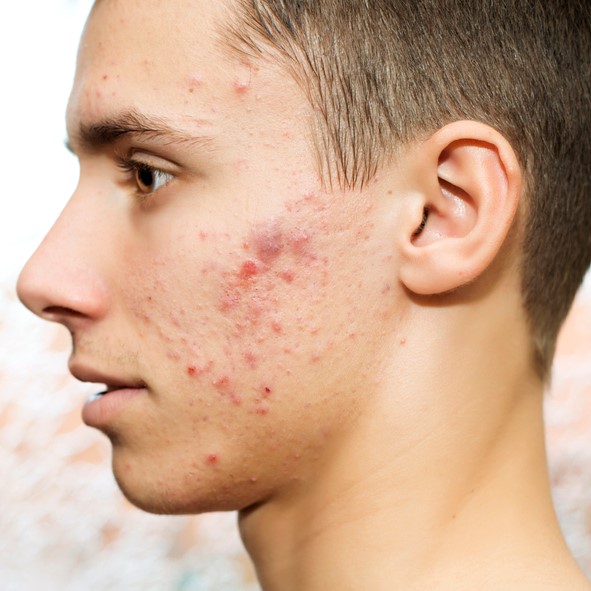
Active acne and acne scars are different problems. This page focuses on active acne: comedones, inflammatory spots, deeper nodules, adult acne and the risk of permanent scarring. Established acne scars are assessed separately on the Acne Scar Treatment page.
Acne treatment starts with the correct diagnosis
Acne vulgaris is a common inflammatory disorder of the pilosebaceous unit. It may appear as blackheads or whiteheads, red inflammatory papules, pustules or deeper painful nodules. The pattern can change with age, hormones, medications, skin-care products, friction and other individual factors. Acne can also be confused with rosacea, folliculitis, perioral dermatitis and several other conditions, so treatment should not be based only on the location of a breakout or a photograph.
At a dermatology assessment, the aim is to identify the dominant lesion type, severity, distribution, skin-barrier condition, previous treatments, risk of scarring and the effect of acne on daily life. Blood tests or hormonal investigations are not routinely necessary for everyone; they are considered when the history or examination suggests a specific underlying issue and when the result would change management.
Different acne patterns need different plans
Comedonal acne
Open and closed comedones are caused by follicular plugging. Treatment usually focuses on preventing new blockage and normalising follicular turnover rather than squeezing or repeatedly extracting lesions at home.
Inflammatory acne
Red papules and pustules reflect a stronger inflammatory component. The number of lesions is important, but so are their depth, duration, body involvement and tendency to leave persistent colour changes or scars.
Nodular or high-scar-risk acne
Deep, painful nodules may cause more tissue damage and carry a higher risk of permanent scarring. These cases generally need earlier medical assessment rather than repeated over-the-counter product changes.
Adult acne
Acne may persist beyond adolescence or begin in adulthood. Recurrent lower-face acne can sometimes be influenced by hormones, but its location alone does not diagnose a hormonal disorder. Menstrual irregularity, increased facial or body hair, scalp hair loss, medication use and other clinical clues help determine whether targeted investigation is appropriate.
Truncal acne
Acne on the back, chest or shoulders may require different formulations and a plan that takes sweating, friction, sports equipment and clothing into account.
How is acne treatment planned?
Treatment is selected according to acne type, severity, scar risk, age, pregnancy potential, previous response and the routine a patient can realistically follow. The goal is not to use the largest possible number of products; it is to control new lesions with an effective, tolerable plan and to review the response over time.
Topical treatment
Depending on the pattern of acne, topical retinoids, benzoyl peroxide, azelaic acid and other prescription or non-prescription options may be considered. Correct application, frequency and management of irritation are as important as the active ingredient itself. Using several irritating products at the same time can damage the skin barrier and make adherence more difficult.
Oral treatment
Oral medication may be considered for more widespread inflammatory acne, deeper lesions or significant scar risk. When oral antibiotics are appropriate, duration and combination therapy should be planned with antimicrobial resistance in mind rather than continuing antibiotic monotherapy indefinitely.
Isotretinoin
Isotretinoin may be considered for severe acne, acne with a high risk of scarring or disease that has not responded adequately to appropriate standard treatment. It is not automatically the first choice for every patient. Medical supervision, side-effect counselling and appropriate monitoring are required. Isotretinoin is highly teratogenic and must not be used during pregnancy; strict pregnancy-prevention requirements apply where relevant.
Hormonal options
In selected adult women, prescription treatments that address hormonal influence may be considered after reviewing medical history, contraindications and pregnancy plans. A lower-face distribution alone is not enough to justify hormonal medication.
Procedures and professional skin care
Selected procedures can sometimes support acne management, but device treatments and cosmetic skin care do not automatically replace evidence-based medical treatment for active moderate or severe acne. Timing matters: controlling new inflammatory lesions usually takes priority over procedures directed at old scars or texture.
Acne, post-acne marks and acne scars are not the same
Flat red or pink marks and brown-grey pigmentation after acne are colour changes, not necessarily true scars. Depressed or raised permanent changes in skin texture are scars. A patient can have active acne, post-inflammatory colour change and established scars at the same time, but each needs a different treatment sequence.
- Active acne: priority is controlling new comedones and inflammatory lesions.
- Brown or grey marks: pigmentation and sun protection are assessed separately.
- Depressed or raised scars: scar type is classified after active acne is controlled. See Acne Scar Treatment in Izmir.
- Supportive skin care: should improve tolerability and barrier function rather than compete with the medical plan. See Skin Care in Izmir.
What happens at an acne assessment?
The consultation may include the age of onset, flare pattern, face and body distribution, pain or itching, menstrual relationship when relevant, family history, current medication and supplements, previous acne treatments and any side effects. Examination looks at comedones, papules, pustules and nodules, as well as skin sensitivity, pigmentation and established scars.
Psychological impact is also clinically relevant. Acne can affect confidence, school, work and social life. Significant distress may justify earlier or more intensive treatment even when the visible lesion count appears modest.
Daily skin care during acne treatment
- Use a gentle cleanser rather than repeated scrubbing or harsh exfoliation.
- Choose moisturiser, sunscreen and make-up labelled non-comedogenic when possible.
- Do not squeeze, needle or pick deep lesions at home.
- Introduce active products according to the treatment plan instead of adding several new acids or exfoliants at once.
- If dryness, burning or peeling becomes difficult to tolerate, review the regimen rather than silently stopping all treatment.
There is no single universal “acne diet”. If a patient notices a consistent relationship with a particular food, that observation can be discussed, but restrictive diets should not replace medical treatment or lead to nutritional problems.
When is response assessed?
Acne does not resolve overnight. Many first-line regimens are assessed over roughly a 12-week clinical period, although review may be earlier when side effects, rapid worsening or high scar risk are present. Follow-up focuses on the development of new lesions, tolerability, adherence, pigmentation and scar risk rather than judging treatment from a few isolated days.
Pregnancy and breastfeeding
Pregnancy, plans for pregnancy and breastfeeding should always be discussed before starting or continuing acne treatment. Some medications are contraindicated and the entire routine—including topical products—may need to be adjusted. Isotretinoin must not be used during pregnancy.
When should acne be assessed promptly?
Deep painful nodules, rapid scarring, widespread truncal acne, significant psychological distress or worsening despite treatment are reasons not to postpone dermatology assessment. A rapidly developing severe or ulcerating eruption with fever or marked systemic illness needs same-day medical evaluation. If acne-related distress is associated with thoughts of self-harm or immediate danger, urgent emergency support is required.
Frequently asked questions
Does every adult with chin acne need hormone tests?
No. Tests are targeted to the history and examination. Menstrual irregularity, increased hair growth, scalp hair loss or other clinical findings may justify further investigation, but acne location alone is not diagnostic.
Can acne be treated without prescription medication?
Some mild acne may respond to a well-chosen topical routine. More inflammatory, nodular or scar-prone acne often requires medical assessment and prescription treatment.
Should acne scars be treated while active acne is still flaring?
Usually the first priority is to reduce new inflammatory lesions and prevent additional scars. Once active acne is adequately controlled, established scars can be classified and treated more specifically.
Can professional skin care replace medical acne treatment?
No. It may be supportive in selected patients, but it does not replace diagnosis or evidence-based treatment for moderate, severe or scar-prone active acne.
Related dermatology pages
This page provides general medical information and does not replace an individual examination, diagnosis or prescription. Medical review: September 2026.