
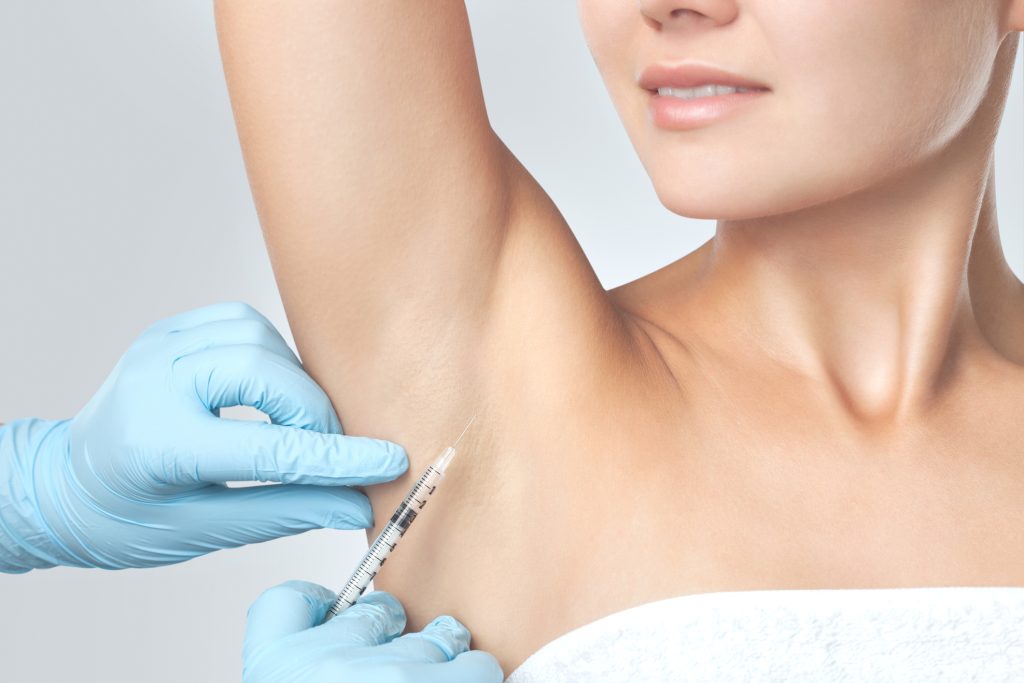
Treat the sweating pattern—not only the wet area
Excessive sweating can be primary and focal, or it can be a sign of medication effects or another medical condition. Botulinum toxin may temporarily reduce severe focal sweating in selected areas, but diagnosis comes before injections and the plan for underarms, palms and soles is not identical.
What is hyperhidrosis?
Hyperhidrosis is sweating that exceeds what is needed for temperature control and causes practical, occupational, social or emotional difficulty. It can soak clothing, make objects slip from the hands, interfere with writing or touchscreen use, damage footwear, irritate constantly wet skin and make ordinary contact uncomfortable.
Sweating after exercise, during hot weather, with fever or during acute stress is not automatically hyperhidrosis. The diagnosis depends on distribution, duration, triggers, sleep pattern, age of onset, medicines, associated symptoms and the effect on daily life.
The most familiar search term is “hyperhidrosis Botox,” but Botox is one brand of botulinum toxin. Botulinum toxin products are prescription medicines with product-specific potency units, licensed indications, preparation and safety information. Units from different products must not be assumed to be interchangeable.
Focal pattern
Sweating is concentrated in defined areas such as both underarms, palms or soles and often follows a long-standing, relatively symmetrical pattern.
Daily-life burden
The problem may affect clothes, work, computers, paper handling, handshakes, footwear, sports, skin integrity and confidence.
Medical context
Generalised, new or night-time sweating can require investigation for medication effects or an underlying condition before symptom-directed treatment.
Primary focal or secondary hyperhidrosis?
Botulinum toxin can reduce sweating where it is injected, but it does not diagnose or treat the cause of secondary sweating. Masking a new systemic symptom without evaluation may delay appropriate care.
Features often seen in primary focal hyperhidrosis
- Focal, visible excessive sweating present for at least several months
- Usually bilateral and relatively symmetrical
- Often begins in childhood, adolescence or early adulthood
- Occurs repeatedly and interferes with daily activity
- May have a family history
- Usually settles during sleep
Features that increase concern for a secondary cause
- Sudden or recent onset, especially later in life
- Generalised rather than clearly focal sweating
- Drenching night sweats or sweating that wakes the patient
- Fever, unexplained weight loss, persistent cough or feeling systemically unwell
- Palpitations, tremor, heat intolerance or symptoms of low blood glucose
- A new medicine, dose change, substance use or withdrawal
- Markedly one-sided or neurologically patterned sweating
Possible secondary contributors include endocrine or metabolic conditions, infection, neurological disease, menopause-related symptoms, malignancy, alcohol or substance withdrawal and medicines such as some antidepressants, analgesics, hormonal treatments or glucose-lowering agents. This is not a complete list. Testing is selected from the history and examination rather than ordered as the same panel for every patient.
When sweating needs medical evaluation before injection
Seek assessment when sweating is new, generalised, predominantly nocturnal or accompanied by fever, unexplained weight loss, chest symptoms, palpitations, fainting, neurological change or another systemic symptom. Botulinum toxin should not be used as a shortcut around diagnosis.
Underarms, palms and soles are assessed separately
Treatment area affects discomfort, injection mapping, functional risk, expected duration and product-label status. An underarm protocol should not simply be copied onto hands or feet.
Underarm hyperhidrosis
Axillary sweating may soak clothing, require repeated changes and cause skin irritation. This is the most established botulinum-toxin indication for hyperhidrosis. The active sweating field can be mapped before a series of superficial injections.
Temporary tenderness, bruising, small raised injection marks or incomplete coverage can occur. Sweat reduction generally develops over days rather than immediately.
Palmar hyperhidrosis
Sweaty palms can interfere with writing, instruments, keyboards, touchscreens, tools and hand contact. Injections are usually more uncomfortable than underarm treatment and require specific pain-control planning.
Temporary weakness—particularly reduced pinch or fine hand strength—is an important functional risk. Occupation, dominant hand, instrument use and the consequences of temporary weakness must be discussed before treatment.
Plantar hyperhidrosis
Excessive sole sweating can contribute to wet footwear, slipping, maceration, odour and recurrent skin problems. Plantar injections can be painful and the response may be less predictable than in the underarms.
Foot function, activity, footwear, skin infection and other causes of wet or damaged feet are reviewed. Pain-control needs and alternatives such as iontophoresis may influence the decision.
| Area | Main functional concern | Planning issue | Area-specific limitation |
|---|---|---|---|
| Underarms | Wet clothing, odour interaction, irritation | Define the active sweating field | Incomplete coverage or temporary local reaction |
| Palms | Grip, paper, devices, hand contact | Pain control and hand function | Temporary finger/pinch weakness may occur |
| Soles | Wet footwear, slipping, maceration | Pain control, walking and skin condition | Variable response and considerable injection discomfort |
Licensing varies by product and country. In US product information, severe primary axillary hyperhidrosis is an established onabotulinumtoxinA indication when topical treatment is inadequate; hand and foot use may be outside a particular product’s licensed indication. Current product information in Türkiye and the individual consent discussion take precedence.
How does botulinum toxin reduce sweating?
Most eccrine sweat glands are stimulated by cholinergic sympathetic nerve signals. When botulinum toxin is injected superficially into a defined area, it temporarily reduces acetylcholine release from local nerve endings. This lowers sweat-gland activity within the treated field.
The treatment does not remove sweat glands, cure the underlying tendency or permanently change the nervous system. Nerve signalling gradually recovers, so sweating returns over time. Untreated parts of the body continue to sweat for temperature control.
Local
The effect is concentrated around the injection field. A missed or undertreated area can continue to sweat.
Gradual
Reduction develops over several days. The day after treatment is too early to judge the response.
Temporary
Many patients experience useful control for around six months, but duration can be shorter or longer and differs by area and individual response.
Who may be suitable for hyperhidrosis Botox?
Assessment may support treatment when
- Focal sweating is persistent and meaningfully disrupts daily life
- The distribution and history are consistent with primary focal hyperhidrosis
- Appropriate topical or area-specific options have been inadequate, poorly tolerated or unsuitable
- The patient understands that benefit is temporary and variable
- Area-specific pain, weakness and follow-up issues are acceptable
- There is no contraindication in current product information
Treatment may be postponed or unsuitable
- Infection, inflammation or significant skin damage at injection sites
- Known hypersensitivity to the selected medicine or its components
- Certain neuromuscular disorders or relevant swallowing/breathing problems
- Important medicine interactions or unresolved reaction to previous toxin
- A secondary cause that has not been evaluated or managed
- A job or activity for which temporary hand weakness would be unacceptable
- Pregnancy or breastfeeding when an elective procedure is being considered
Tell the physician about all prescription and non-prescription medicines, supplements, antibiotics, muscle relaxants, previous botulinum toxin products, neurological conditions, weakness, swallowing or breathing problems, allergies, pregnancy and breastfeeding. Do not stop prescribed medication without the clinician responsible for it.
How hyperhidrosis treatment is planned at the clinic
At Dr. Sedef Demirer’s clinic in Alsancak, the process begins by confirming the sweating pattern and deciding whether botulinum toxin is appropriate for the selected area.
History and severity
Onset, distribution, sleep pattern, triggers, family history, daily-life interference, medicines, previous treatments and systemic symptoms are reviewed.
Examination and cause assessment
The skin and sweating distribution are examined. Investigations or another medical opinion may be recommended when the history suggests secondary hyperhidrosis.
Area mapping
The active field is defined clinically and, when useful, with an iodine–starch test. The plan is adapted to the underarm, palm or sole rather than using one universal template.
Pain-control planning
Underarm injections are usually more manageable than palm or sole injections. Available comfort measures, their limitations and area-specific risks are discussed before proceeding.
Superficial injection pattern
The prescription product is administered in multiple small points across the agreed sweating field. Product, lot, area and treatment plan are documented.
Written aftercare and review
Expected local effects, onset, warning signs and the appropriate time to assess coverage are explained. Re-treatment is not arranged from a fixed calendar alone.
Appointment duration varies with the number and size of treated areas and the pain-control method. Consultation and treatment may sometimes occur during the same visit, but this cannot be promised before medical assessment.
When does sweating decrease, and how long can the effect last?
Reduction usually begins over several days. Many patients can assess a clearer change within about one to two weeks, although timing varies by product, area and individual response. Small areas of residual sweating do not necessarily mean the entire treatment has failed; the original map and response need to be reviewed.
Early period
Injection marks, tenderness or bruising may be present before sweat reduction becomes noticeable.
Developed response
The effect is judged by practical improvement and the treated sweating field—not by a promise of complete dryness.
Following months
Useful control often lasts around six months, but published studies and clinical experience show substantial variation. Underarms, palms and soles may not last equally.
Repeat treatment is considered when clinically significant sweating has returned and the selected product’s minimum interval and instructions are satisfied. A shorter or longer effect does not by itself prove poor or superior treatment.
Side effects and warning signs
No injection is risk-free. Side effects depend on the medicine, dose pattern, treated surface, depth, anatomy and individual health factors.
Local or more commonly discussed effects
- Injection pain, tenderness, redness or bruising
- Temporary swelling, itching or small raised injection marks
- Headache or flu-like symptoms
- Incomplete or uneven sweat reduction
- Excessive dryness in the treated field
- Temporary hand or finger weakness after palmar treatment
Important area-specific considerations
- Palm and sole injections can be considerably painful
- Hand weakness may affect fine motor tasks, instruments or manual work
- Incorrect depth near functional muscles may increase unwanted weakness
- Skin infection or maceration should be addressed before injection
- Reducing sweat does not directly treat fungal or bacterial infection
Rare spread-of-toxin symptoms require urgent care
Botulinum toxin product information warns that effects may spread beyond the injection area. New generalised weakness, double or blurred vision, drooping eyelids, difficulty speaking, swallowing or breathing, or loss of bladder control requires urgent medical assessment.
Do not wait for a WhatsApp response. In Türkiye, call 112 or attend the nearest emergency department for breathing, swallowing, speech or severe generalised symptoms.
Call 112Authentic prescription product, correct transport and storage, traceability, appropriate patient selection and knowledge of anatomy are essential. Do not buy botulinum toxin online, self-inject or receive injections in a non-medical setting.
Aftercare following hyperhidrosis injections
Aftercare may differ by treatment area and pain-control method. Written instructions from the physician who examined and treated you take priority over generic internet advice.
Routine early care
- Keep injection sites clean and avoid unnecessary rubbing or firm pressure.
- Follow area-specific advice on deodorant, skin products, exercise, heat and footwear.
- Do not judge sweat reduction on the first day.
- Monitor hand function after palmar treatment before demanding manual tasks.
- Use only medicines approved for your circumstances.
Contact the clinic
- Pain, redness, swelling or warmth is increasing rather than settling.
- There is drainage, spreading inflammation or another sign of infection.
- Hand weakness is marked, unexpected or interferes substantially with function.
- Sweating remains untreated in a clearly defined part of the mapped field.
- Any unexpected or concerning symptom develops.
Alternatives and complementary hyperhidrosis treatments
The appropriate option depends on whether sweating is focal or generalised, the affected area, severity, previous response, skin tolerance, medical history and personal priorities.
Clinical-strength antiperspirants
Topical aluminium-salt preparations are often considered early, especially for axillary disease. Irritation and inadequate control can limit use.
Iontophoresis
Hands and feet are placed in water through which a low electrical current is passed. It requires repeated initial and maintenance sessions and may be preferable for some palmar or plantar cases.
Topical prescription medicines
Topical anticholinergic products may be available for selected areas and ages. Availability, licensing, transfer to the eyes and systemic anticholinergic effects require product-specific advice.
Oral medicines
Systemic anticholinergic medicines can reduce sweating in multiple areas but may cause dry mouth, blurred vision, constipation, urinary difficulty, overheating and other effects.
Device-based underarm options
Selected technologies target axillary sweat glands. Availability, evidence, permanency, cost and risk differ and should not be assumed to apply to palms or soles.
Surgical referral
Surgery is reserved for selected severe cases because complications can include compensatory sweating and procedure-specific risks. It is not a routine first choice.
If secondary hyperhidrosis is suspected, treatment of the underlying condition or review of a contributing medicine with the relevant clinician may be more important than any sweat-blocking procedure.
Hyperhidrosis assessment in Izmir for international patients
Dr. Sedef Demirer’s private dermatology clinic is in Alsancak, Konak, Izmir. Routine consultation and treatment planning can be conducted in English, German or Turkish.
Before travelling, share which areas are affected, when sweating began, whether it occurs during sleep, regular medicines, relevant medical conditions, previous treatments and travel dates. Photographs cannot establish the sweating volume, rule out secondary causes or determine the product and dose plan.
Palm and sole treatment may require more time and pain-control planning than underarm treatment. Consider early tenderness and the possibility of temporary hand weakness when arranging work, driving, sport, instruments or manual activities. Consultation and injection may sometimes occur on the same day, but cannot be guaranteed before assessment.
What affects hyperhidrosis Botox prices in Izmir?
Cost depends on the treated area, size of the active sweating field, prescription product, amount required, whether one or both sides are treated, pain-control needs and follow-up plan. Underarm, palm and sole treatments do not use identical injection patterns or quantities.
Botulinum toxin potency units are product-specific and not directly interchangeable. Comparing clinics only by a quoted number of “units” can therefore be misleading. Diagnosis, authentic product, traceability, storage, medical administration and management of area-specific risks are part of treatment.
Review Botox pricing factors on the main Botox page. Current information and the final scope are provided after an adequate assessment and in accordance with applicable rules in Türkiye.
Hyperhidrosis Botox FAQ
Is excessive sweating always primary hyperhidrosis?
No. New, generalised or night-time sweating may be related to medicine, endocrine or metabolic conditions, infection, neurological disease, menopause, malignancy or another cause. The pattern and associated symptoms should be assessed first.
Which areas does Dr. Sedef Demirer assess for sweating treatment?
Focal excessive sweating of the underarms, palms and soles can be assessed. Each area has a different injection pattern, discomfort level, functional risk and expected response.
How does botulinum toxin reduce sweating?
It temporarily reduces acetylcholine release from local nerve endings that stimulate eccrine sweat glands. The effect is limited to the treated field and gradually wears off as nerve signalling recovers.
When will I notice less sweating?
Reduction usually begins over several days, and a clearer response is often assessed at about one to two weeks. Timing varies by product, area and individual response.
How long does hyperhidrosis Botox last?
Many patients experience useful control for around six months, but the duration may be shorter or longer. The underarms, palms and soles may respond differently.
Are palm injections painful?
Palmar injections can be considerably more uncomfortable than underarm treatment. Pain-control options and their limitations should be discussed before treatment.
Can palmar Botox weaken the hands?
Temporary finger, pinch or hand weakness can occur because functional muscles lie close to the treatment area. Occupation, instrument use, sport and fine-motor requirements should be considered beforehand.
Is foot sweating treated in the same way as underarm sweating?
No. Sole injections are generally more painful, the active area and skin are different, and response may be more variable. Iontophoresis or other approaches may be preferable for some patients.
Does reducing underarm or hand sweating stop the body cooling itself?
The treatment affects a limited injected field. Untreated sweat glands elsewhere continue to function. The goal is reduction of excessive focal sweating, not elimination of whole-body thermoregulation.
What are the main side effects?
Injection pain, tenderness, redness, bruising, temporary raised marks, itching, headache, incomplete coverage and excessive local dryness may occur. Palmar treatment has an additional risk of temporary hand weakness.
Can consultation and treatment occur on the same day?
They may be possible in selected cases, but cannot be promised. Secondary-cause assessment, skin infection, previous reactions or pain-control requirements may make investigation or staged planning more appropriate.
Are consultations available in English or German?
Yes. Routine hyperhidrosis consultation and planning at Dr. Sedef Demirer’s clinic can be conducted in English, German or Turkish.
Sources and scope of this guide
This page provides general information and does not replace diagnosis, examination, product-specific prescribing information, consent or emergency care. Medical content was cross-checked against:
- European Medicines Agency: Botox referral for primary axillary hyperhidrosis
- FDA: approved botulinum toxin products and boxed warning
- Randomised placebo-controlled trial in bilateral primary axillary hyperhidrosis
- Randomised study of palmar hyperhidrosis, sweating response and hand strength
- American Academy of Dermatology: primary and secondary hyperhidrosis
Approved indications, products and instructions vary by medicine and country. Information from US or European sources does not determine approval status in Türkiye; current local product information and individual medical judgement take precedence.
Request a hyperhidrosis assessment with Dr. Sedef Demirer
Treatment planning should be performed individually. At the clinic in Izmir, Dr. Sedef Demirer assesses whether sweating is primary or secondary, how severely it affects daily life and whether underarm, palm or sole botulinum toxin treatment—or another approach—is appropriate.
Important: Results of surgical or interventional procedures may vary from person to person. A detailed medical consultation before treatment is recommended.
Her cerrahi veya girişimsel işlemde sonuçlar kişiden kişiye değişiklik gösterebilir. İşlem öncesinde hekiminizden detaylı görüş almanız önerilir.
Product, brand and commercial independence notice
Where a trade name, product name or related image appears on this page, it is included solely for general medical information and to explain the treatment or method. Unless expressly stated otherwise, Dr. Sedef Demirer has no sponsorship, advertising, agency, representation or paid promotional relationship with the manufacturer, importer, distributor or trademark owner of any product mentioned, and receives no advertising or promotional income from such display. Reference to a product or brand does not constitute a recommendation, claim of superiority or promise that it will be used for every patient. All trademarks and other intellectual-property rights belong to their respective owners. Treatment and product selection are determined by the physician according to medical assessment, indication, applicable regulations, current scientific knowledge and the individual clinical needs of the patient.