
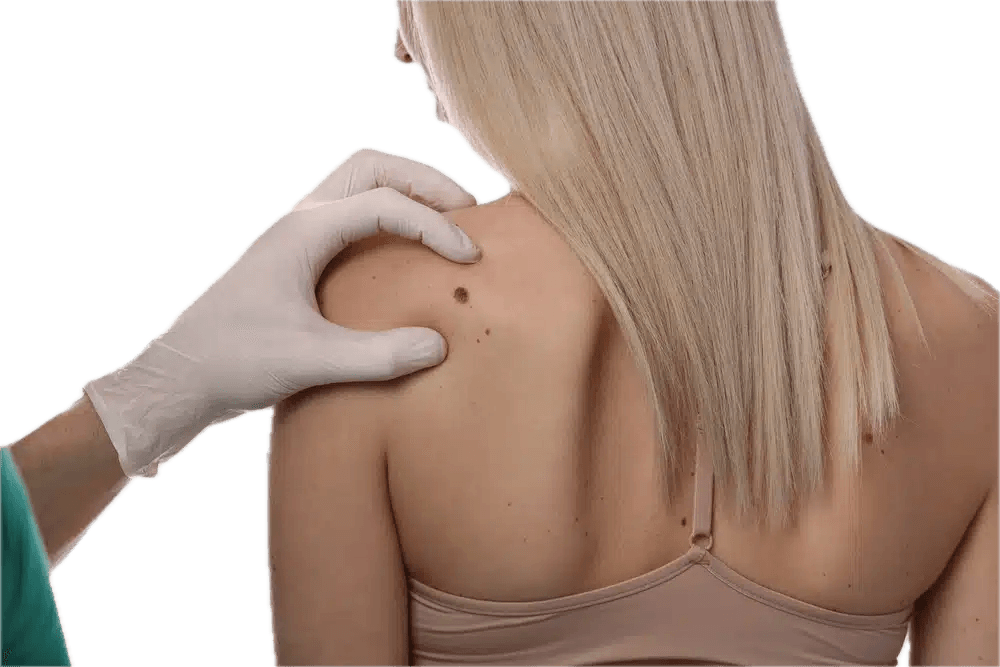
What Is Laser Mole Removal?
CO₂ laser treatment may be used for selected benign raised moles or other suitable skin lesions after dermatological assessment. The tissue is removed in a controlled manner, but laser treatment still creates a wound and can cause redness, pigment change, textural change or scarring. Suspicious or histologically important lesions should not be cosmetically destroyed with a laser.
What Is a Carbon Dioxide (CO₂) Laser?
A CO₂ laser emits a high-energy beam of light that gently vaporizes mole tissue layer by layer.
Because CO₂ laser can ablate tissue in a controlled way, it may be suitable for selected superficial or raised benign lesions. Depending on lesion type and depth, healing may occur without sutures, but nearby skin is still exposed to thermal injury and careful wound care is required.
Advantages of Laser Mole Removal
Controlled and Precise: The laser allows the mole to be removed layer by layer, offering excellent control during treatment.
Scar profile depends on the lesion and method: CO₂ laser may avoid sutures in selected lesions, but it still creates a wound. Pigment change, textural change or a visible scar can occur, and surgical excision may be the more appropriate option when histology is needed.
Reduced Bleeding: The laser seals small blood vessels as it works, minimizing bleeding.
Fast Recovery: The treated area heals quickly, and patients usually experience little to no downtime.
How Is Laser Mole Removal Performed?
The treatment is carried out by a qualified dermatologist in a clinical setting.
Local anesthesia is applied to numb the area and ensure comfort.
The laser beam vaporizes the mole tissue layer by layer.
After the procedure, an antibiotic cream is applied and the area is covered with a protective dressing.
During the healing process, sun protection and proper skincare as advised by your doctor are essential.
Who Is a Good Candidate for Laser Mole Removal?
Laser mole removal using CO₂ laser is generally suitable for:
Individuals seeking mole removal for cosmetic reasons,
Medically necessary mole removal, such as for benign but irritated moles,
Moles in sensitive areas of the face or body where precision is crucial.
Laser Mole Removal – Frequently Asked Questions
What is laser mole removal and how is it performed?
Laser mole removal is a non-surgical method that eliminates unwanted moles using focused laser energy.
The laser ablates the selected lesion tissue in a controlled way, but nearby skin is still exposed to heat and healing response; redness, pigment change, textural change or scarring can occur.
Can all moles be removed with a laser?
No. Not every mole is suitable for laser removal.
Before treatment, a dermatologist must confirm that the mole is benign.
Suspicious, irregular, or rapidly growing moles should be surgically excised and sent for pathological examination.
Is the procedure painful and how long does it take?
The procedure is performed under local anesthesia and causes minimal discomfort.
Depending on the mole’s size and location, treatment typically lasts 5–20 minutes.
Will there be a scar after laser mole removal?
In most cases, scarring is minimal.
Temporary redness, scabbing, or slight discoloration may occur but usually resolve within a few weeks as the skin heals.
What should be considered after the procedure?
The treated area should be protected from sun exposure, and healing creams recommended by your dermatologistshould be used.
Mild redness or crusting is normal and temporary.
Follow-up visits are important to monitor healing and ensure the mole does not recur.
What Affects Mole Removal Cost in Izmir?
Mole or skin-lesion removal cost should be discussed only after the lesion has been examined. The first question is not “laser or price?” but whether the lesion appears benign, whether dermoscopy is sufficient, and whether tissue should be preserved for histopathology.
- Diagnosis and method: CO₂ laser may be appropriate for selected benign lesions, while suspicious or histologically important lesions may require surgical excision instead.
- Number and size of lesions: one small raised lesion and multiple or larger lesions require different treatment time and wound care.
- Location and depth: facial, body or anatomically sensitive sites may need different planning.
- Histopathology: when tissue diagnosis is clinically indicated, pathology and the removal method become part of the treatment plan.
- Follow-up and wound care: healing, pigment change, recurrence or scar concerns may require reassessment.
For this reason, a personalised fee can only be discussed after the lesion type and appropriate removal method are established.
Important Notes
Not all moles are suitable for laser removal. Suspicious or atypical moles must be surgically excised and examined histologically.
Before treatment, the type and nature of the mole should always be assessed by an experienced dermatologist.
Everyone’s skin heals differently, and results may vary.
For detailed information and a personalized treatment plan, consult your dermatologist.
Dermatologist Dr. Sedef Demirer (Alsancak, İzmir) performs laser mole removal procedures in her dermatology clinic using advanced CO₂ laser technology.
Want to learn more about our advanced laser solutions? Visit our Fractional CO₂ Laser main page to explore all available treatments, including Acne & Scar Treatment, Laser Skin Rejuvenation, Scar & Stretch Mark Treatment, Laser Mole Removal, Laser Genital Treatments and HPV & Warts Treatment — all performed with precision and care by experienced specialists.
You can click to return to the homepage.
Moles and other skin lesions should be diagnostically assessed before a removal method is selected. Learn more about the clinic and dermatology services on the Dr. Sedef Demirer homepage.